¶ ELECTRIC HEATER
The heater unit contains a heat exchanger with resistance bodies, an operational thermostat set to a fixed value of +50°C, and a safety thermostat set to +80°C. The resistance rods are already connected as standard from the factory and, along with the thermostats, are brought to the terminal box. The terminal box is mounted on the heat exchanger for CPV from the service side and for CPX from the door side.
For the electric heater, it is essential to maintain a minimum cross-sectional air velocity of 1 m/s under all operating conditions and modes to ensure heat dissipation from the heating elements.
The electric heat exchanger is designed for a voltage of 3~400V/50HZ and may contain multiple sections.
 The surface temperature of the heating rods during operation greatly exceeds the safe touch temperature of 60°C. Before starting any interventions or work on the chamber, one must wait for sufficient cooling of the heating rods and the chamber!
 Any interventions in the electric heater may only be carried out by personnel with professional qualifications according to the applicable regulation of the country in which the unit is put into operation.
We check the condition and contamination of the heating elements, and if necessary, clean them with a vacuum cleaner.
Additionally, it is necessary to check the functionality of the airflow control device and the operational and safety thermostat. In the electric heating chamber, it is essential to maintain a minimum cross-sectional air velocity of 1 m/s under all operating conditions and modes to ensure heat dissipation from the heating elements.
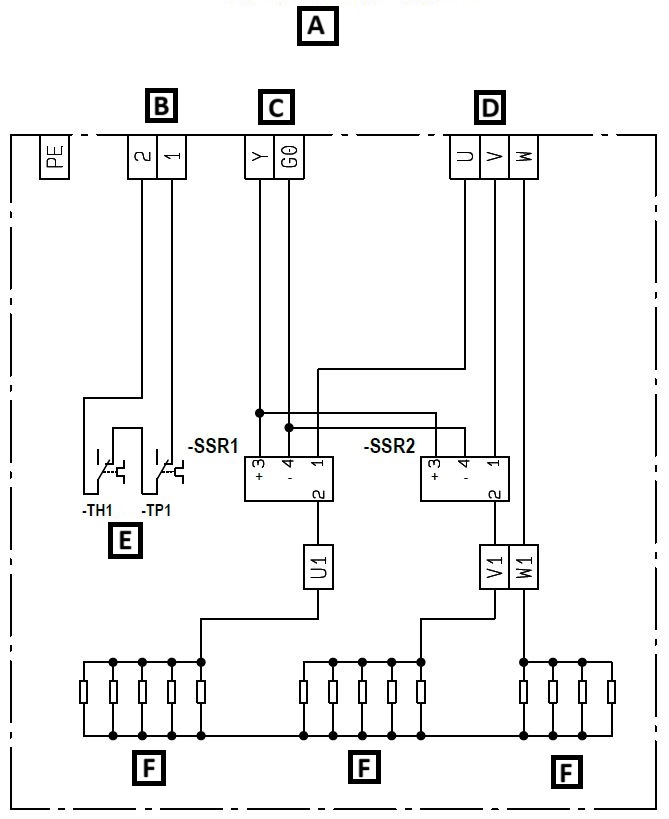
A: Electric Heating
General Diagram
B: Control Power
C: PWM Signal
D: Power Supply
E: Protective Thermostats
F: Heating Rods
Access to the terminal box is possible after removing the cover with a 5.0 mm hex key.
The heater's terminal box is equipped with a DIN rail with terminals for power connection, SSR relay for power switching, and operational and safety thermostats for safe operation, see the image:
A: DIN RAIL WITH TERMINALS
B: SAFETY THERMOSTAT
C: OPERATIONAL THERMOSTAT
D: SSR RELAY
The operational and safety thermostats must always be properly connected to the control system. The thermostats are wired in series, and at safe air temperatures inside the heater, their contacts are closed. When the contact opens, the electric heater must turn off. The operational thermostat resets automatically when the heater cools down; the safety thermostat must be reset manually. Between the moment of thermostat overheating and the possibility of manual unlocking, the temperature must drop below the value set on the thermostat. A condition for restarting the heater is the removal of the cause of overheating. The operational thermostat is standardly set to a temperature of approximately 50°C in the airflow, while the safety thermostat is set to a temperature of approximately 80°C in the appropriate area of the heater, which is influenced by the radiation of the heating elements.
A: POSITION OF THE SAFETY THERMOSTAT IN THE RESTING STATE. IF TRIPPED, THE RED RESET BUTTON MUST BE PUSHED BACK MANUALLY.
C: SETTING OF THE TRIPPING TEMPERATURE OF THE OPERATIONAL THERMOSTAT
D: SETTING OF THE TRIPPING TEMPERATURE OF THE SAFETY THERMOSTAT

The electrical wiring of the heater is specified in the attached documentation "Measurement and Control MANDÍK."
The airflow velocity in the effective cross-section of the unit must not be less than 1 m/s, otherwise, the heating elements will overheat. For units with variable air output, it is necessary to address this by setting a higher value for the minimum speed.
Operation of the electric heater: WARNING: The heater must not be turned on without ensuring the simultaneous operation of the fan!
It is imperative to ensure airflow through the heater, i.e., first turn on the fan and wait for the normal operating point to be reached according to its start-up time. The heater can only be started after this condition is met. Likewise, the fan must continue to run for at least 5 minutes after the heater is turned off to ensure sufficient cooling of the heating elements. Failure to comply with this condition absolves the manufacturer of any responsibility for damage caused by heat accumulated in the body of the electric heater.
The standard electric heater must not be placed in an explosive atmosphere, and explosive and easily flammable materials must not be stored near the electric heater.