¶ ASSEMBLY AND INSTALLATION FOR KJM
¶ GENERAL POSITIONING OF THE UNIT
• The minimum space for basic maintenance and service is 600 mm on the service side
• The minimum space for repair and replacement of equipment is the unit width + 200 mm
• The minimum distance of combustible objects from the unit is 200 mm
• Units intended for outdoor installation must, for stability reasons, be sufficiently fixed to the foundation according to the expected climatic conditions
¶ POSITIONING THE UNIT ON THE FLOOR
• Pay attention to the permitted handling of chambers, as specified in the previous chapter (here).
The unit must be supported (by the floor/steel frame) along the entire perimeter of its base frame, including the internal frames – otherwise there is a risk of deflection of the chamber bottoms and damage to the internal structures of the built-in components!!!
• The units must be placed on a solid horizontal surface to which they can be firmly anchored. It is advisable to place damping material (e.g. rubber, cork) under the unit base frame at the installation site
• The maximum permitted deviation from level is 0.5% (0.3°)
• If the unit is installed outdoors, it is recommended to place the unit on a steel frame (supplied by the building contractor). The maximum permitted frame deflection is 1/1000 of the frame beam length
• A sufficient height of the unit above the floor/ground must be taken into account to ensure a sufficient siphon height for chambers equipped with a condensate drain; see the section SIPHON INSTALLATION.
Failure to maintain the stability or levelness of the supporting surface may result in impaired function of the unit or even damage to it, such as misalignment of the rotor of the rotary heat recovery chamber, failure of chamber doors to close properly, misalignment of chamber connection openings, etc.!
• Units with chambers placed above one another may be equipped with centre frames for easier handling. Assembly of chambers with centre frames is specified in Appendix A. ASSEMBLY OF CHAMBER CENTRE FRAMES
¶ POSITIONING THE UNIT UNDER THE CEILING
• The service side of fan, filter and other chambers fitted with doors or service panels must be positioned facing downwards
• For correct operation, the unit must be positioned horizontally
• Chambers of the unit intended for suspension under the ceiling are normally factory-fitted with components intended for this purpose, such as suspension L-profiles or Z-profiles fitted with rubber stabilizers to reduce the transmission of vibration and noise into the building structure, see the figure:
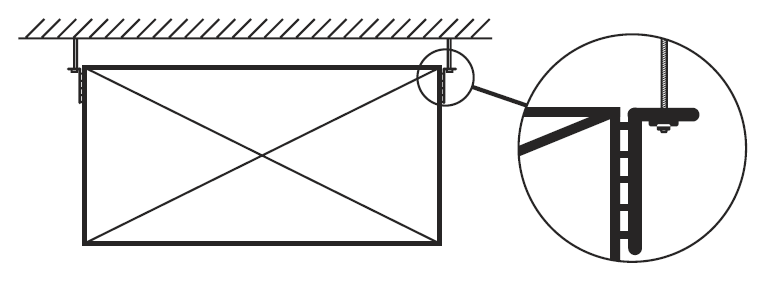
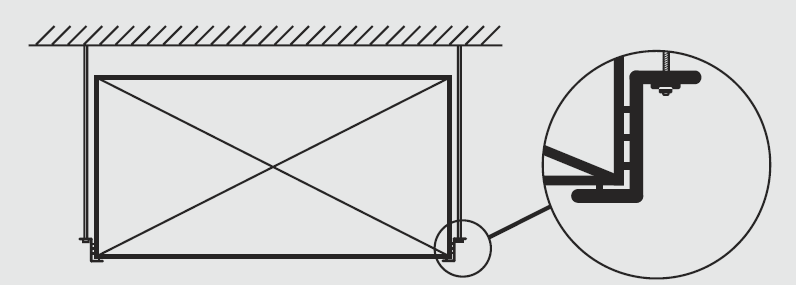
• Standard suspension equipment intended for air handling units, such as profiles or threaded rods, may be used for suspending and supporting the units. To reduce the transmission of vibration and noise, it is recommended to use standard spring elements!
• Suitable lifting equipment, such as a forklift truck, lifting platforms, etc., must be used for lifting the unit chambers
• When installing the unit in a suspended ceiling, the suspended ceiling structure must be provided with openings for maintenance and service